Car stacker or car lift: which suits a collection?
A car stacker parks one car above another in the same bay. A car lift moves a car between floors, down to a gallery. A stacker adds spaces. A car lift gives every car its own bay.
Both are sold for home garages, and the names often get mixed up. This guide explains the types of stacker, and the heights and loads they need. It also shows when a car lift is the better answer.
Updated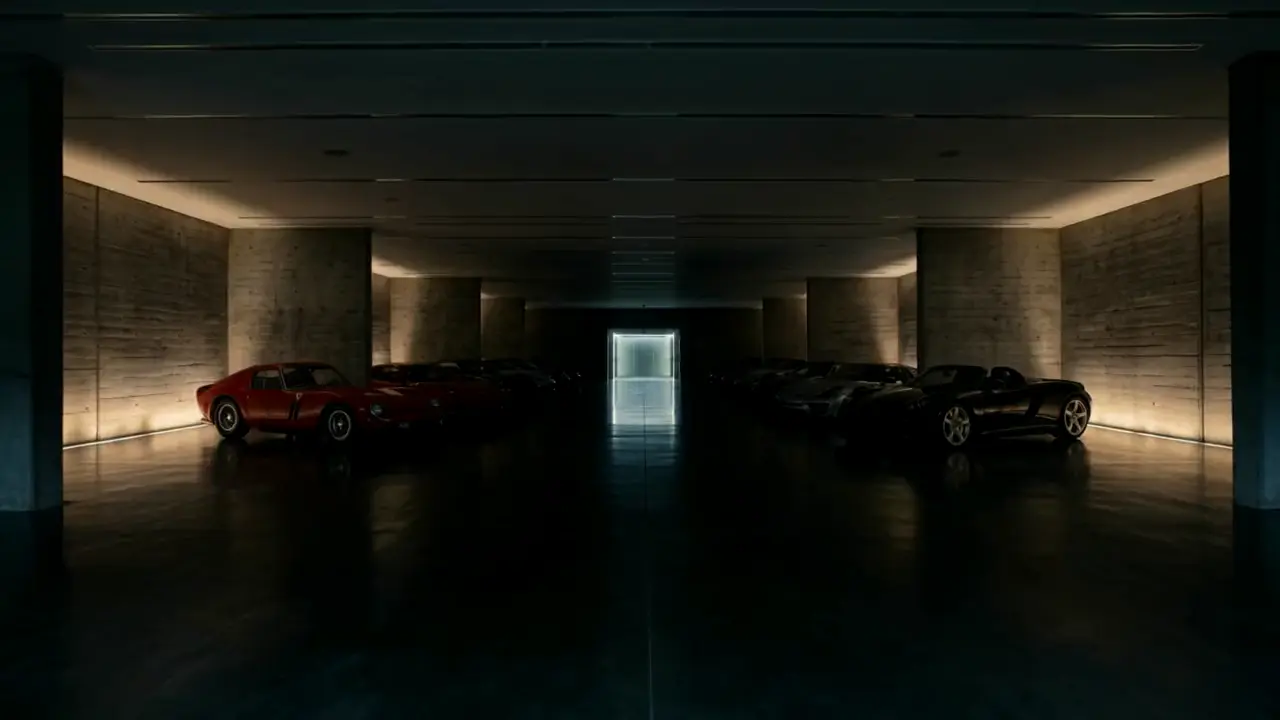
Two machines, two jobs
A stacker is parking equipment. It doubles the cars in one bay by lifting one above the other.
A car lift is a route between floors. It takes each car down to its own bay in a gallery.
Our guide to car lifts for the home explains all four types.
Dependent stackers
In a dependent stacker, the lower car moves out first. Then the upper platform comes down. Wöhr's Parklift 411 works this way.
Height is the first test. Wöhr's data sheet gives a clear height of 3.2m. That suits two cars up to 1.5m tall.
It needs 5.2m of length for a 5m car. Platforms take 2,000 kg or 2,600 kg. With extra equipment, the Parklift 411 can stand outdoors.
Independent stackers over a pit
An independent stacker sits partly in a pit. Each car can then leave without moving the other.
Wöhr's Parklift 450 and 405 take cars 150 to 220 cm tall. Single units have platforms up to 300 cm wide.
Platform loads are 2,000 kg or 2,600 kg. Some platforms slope. The lower Parklift 405 platform is reached up a 14% gradient.
Both Parklift 340 platforms are driven onto at a 9% incline. It needs a 155 cm pit. Clear height is 295 cm or 305 cm.
Check every low car against a sloping platform before you choose one.
Driveway lifts
A driveway lift is a stacker sunk into the ground under a flush lid. The Wöhr Parklift 462 parks two or four cars below the drive.
Its top platform sits level with the ground. Wöhr builds these to the Machinery Directive and EN 14010.
Weight and the parking standard
EN 14010 is the standard for power-driven parking equipment. It covers cars under 2,500 kg, and excludes equipment that carries people.
Many collector and electric cars are heavy. UK government guidance notes weight gains of over 35% in popular models.
So check each platform load against your heaviest car. Then check it against the next one.
A drive-through car lift
A car lift carries the car with the driver still inside. Up to 0.15 m/s it is type-tested to EN 81-41. Faster lifts are built to EN 81-20.
Lödige designs its hydraulic car lifts for up to 3,500 kg. The axle load can reach 1,750 kg.
A drive-through lift has a door at each end. So the car always moves forwards. Our guide to car lift dimensions gives the space it needs.
Which suits a collection
- A stacker adds a space or two for everyday cars, in a tall garage.
- A driveway lift hides one or two cars under a drive.
- A car lift and a gallery keep every car within reach, dry and secure.
A collection is meant to be driven and enjoyed. In a gallery, no car waits for another to move.
A drive-out ramp means a lift service never traps the cars. Our guide to designing a garage for a collection explains the layout.
Questions
- What is the difference between a car stacker and a car lift?
- A stacker parks one car above another in the same bay. A car lift carries a car between floors. It can serve a whole gallery below ground.
- What ceiling height does a car stacker need?
- It depends on the model and the cars. The Wöhr Parklift 411 needs 3.2m for two cars 1.5m tall.
- What is a dependent car stacker?
- In a dependent stacker, the lower car moves out first. Then the upper platform comes down. An independent stacker sits over a pit, so each car leaves on its own.
- Can a stacker take a heavy electric car?
- Check the platform load. Wöhr offers 2,000 kg and 2,600 kg platforms. EN 14010 covers parking equipment for cars under 2,500 kg.
- Is a stacker or a car lift better for a collection?
- A car lift with a gallery. Every car has its own bay and can leave without moving another. A drive-out ramp keeps the cars free during lift servicing.
Sources
- Wöhr, Parklift 411 product page (dependent stacker)
- Wöhr, Parklift 411/5 data sheet (June 2026)
- Wöhr, Parklift 450 product page
- Wöhr, Parklift 405 product page
- Wöhr, Parklift 340 product page
- Wöhr, Parklift 462 product page
- Wöhr, Parklift 461 product page
- Standard Norge, NS-EN 14010 power-driven parking equipment scope
- UK government, Covered car parks: fire safety guidance for electric vehicles, section 2 (July 2023)
- Lödige, Car lift planning guide (Traffico and Carrico)