For car collectors
A collection needs more than a large garage. BELOW designs galleries for classic car, supercar and hypercar collectors, with fire, climate, security, charging and display designed in from the first sketch, and a drive-through lift with an independent second way out.
This page sets out what a collection needs below ground, what insurers tend to ask about storage, and how we work alongside the people who already look after your cars.
Updated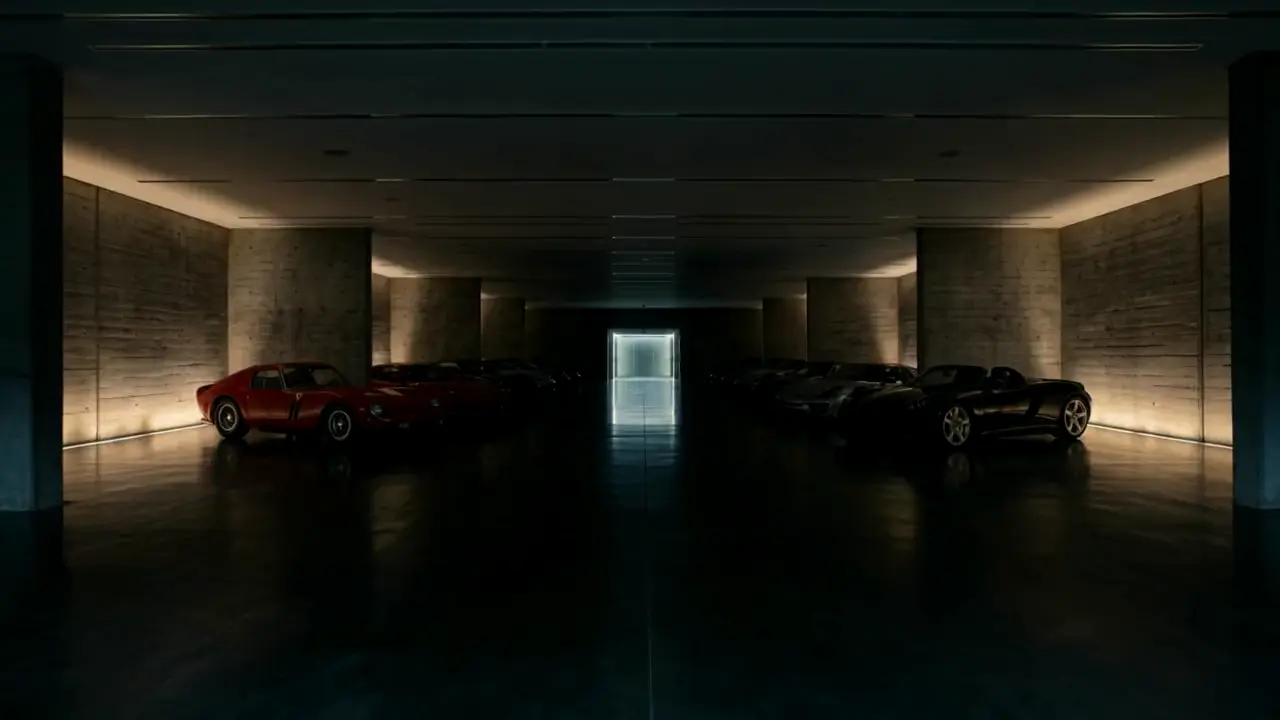
Fire is designed in, not added
Published insurer guidance asks for fire alarms connected to an alarm receiving centre and, where possible, suppression such as sprinklers. It also suggests inert gas extinguishers, because fine powder can mark a car's finish.
We agree the fire strategy at concept stage, with a fire engineer and your insurer. Electric car fires behave differently, and the wrong system can harm the cars it is meant to protect. A pre-action sprinkler system, with pipes kept dry until a fire is confirmed, is our starting point.
The gallery opens to the house through an air-lock lobby with self-closing fire doors, so smoke and fumes stay out of the house. The BELOW Standard sets out the principles.
Humidity and temperature held steady
Classic car specialists describe moisture as arguably the biggest killer of classic cars, because metal, leather, fuel and oils all degrade with it. In spring and autumn, mild days and cold nights take a garage past its dew point. One specialist suggests a dehumidifier aiming for around 55% relative humidity.
Insurer guidance also points collectors to climate-controlled storage that avoids swings in temperature and humidity. In a BELOW gallery, all outdoor air is dried before it enters, and separate units hold the room between purges, with a spare in reserve. Humidity is held within a band agreed for your collection. Our air and climate guide explains the system.
Security and monitoring
Insurer guidance asks for a secure, enclosed space with locks, and access limited to trusted and vetted people. We go further, with security in ten layers from the estate edge to the car.
The gallery has no windows, and the only visible building is a pavilion that reads as a garden room. Inside, an air lock, rated walls and a screened key store protect the cars. At the car itself, trackers, a second-factor immobiliser, battery isolators and, on classics, clamps and forensic marking finish the job. Our car gallery security guide sets out every layer.
The lift and the second way out
You drive forward onto the lift inside the pavilion, it lowers, and you drive forward off it below. There is no turning and no reversing at either end. Our residential car lift guide explains how it works.
Every BELOW gallery also has an independent second route, normally a drive-out ramp, so no car depends on one machine. In a power cut, the car lift lowers safely on battery to the lowest level and opens its doors.
Battery conditioners and charging
Classic car specialists note that a battery left in a laid-up car runs down over time, even when disconnected, which can damage it. Insurer guidance recommends a battery maintenance device for stored cars, and a good-quality trickle charger that meets the right standards.
Charging electric cars brings more fire risk. Published guidance asks for charging circuits that are purpose-built, dedicated to charging, never shared and never extended with extra cables. It also asks for the fire alarm to cut power to the chargers when it activates.
So each bay is planned with its own protected supply for a conditioner or a charger, and the chargers are linked to the fire alarm from the start.
Display lighting and space
Insurer guidance suggests leaving room between cars and keeping shelves and racks away from above them. A gallery gives every car its own bay, room to open its doors and a clear aisle.
Each gallery is lit for the cars it holds, with light lines and display lighting chosen with the house. A turntable can present one car at a time. Our guide to designing a garage for a collection sets out the layout, and our car turntable guide explains the options.
A workshop or detailing bay, kept apart
Published insurer guidance warns against maintenance and repairs in the storage space itself, because oil, grime and fuel are a fire hazard. So a workshop or detailing bay sits in its own room off the aisle, separated for fire, with its own extract.
If the workshop has a two-post service lift, the HSE's guidance on working arm locks and daily checks applies. Our guide to car stackers and car lifts explains how a service lift differs from a car lift.
What an insurer will ask about storage
- Is the space secure and enclosed, with good locks, and is access limited to vetted people?
- Is the wiring sound, and are combustible materials kept to a minimum?
- Is fire detection connected to a central alarm station, and is there suppression?
- Is the climate controlled, with steady humidity and temperature?
- How are batteries maintained, and how are any electric cars charged?
Some specialist insurers also send loss-prevention specialists to inspect a valuable collection. We suggest your insurer reviews the specification before the build begins, so the gallery is insurable from the first sketch. Our car vault guide covers this in more depth.
Working with your advisers
Most collections already have people around them: a dealer, a restorer, an auction specialist, an insurer and often a family office. We work alongside them, never in place of them, and we claim no partnership with any of them.
One named BELOW lead is the point of contact for all of them. Drawings are shared on a need-to-know basis, and an NDA is available on request. Our page for family offices and private clients explains how we report.
How a project starts
- A private consultation, at your home or ours, about the house, the collection and how you use it.
- A feasibility study covering the site, the planning route, the ground and the lift.
- A costed proposal with a programme, before anything is committed.
Our underground garage cost guide explains what drives the budget.
Questions
- What does a car collection need below ground?
- A fire strategy agreed with your insurer, steady humidity and temperature, layered security, a drive-through lift with an independent second way out, protected power for battery conditioners and charging, and room and light to enjoy the cars.
- What humidity should a car collection be kept at?
- One classic car specialist suggests aiming for around 55% relative humidity in a garage. In a BELOW gallery, humidity is held within a steady band agreed for the collection, with a spare dehumidifier in reserve.
- Can electric cars be charged in the gallery?
- Yes, on purpose-built circuits dedicated to charging, never shared or extended, and linked to the fire alarm so power to the chargers is cut if it activates.
- Can I have a workshop in the gallery?
- Yes, as its own room off the aisle, separated for fire and with its own extract. Insurer guidance warns against repairs in the storage space itself.
- Will you work with my restorer and my insurer?
- Yes. We work alongside your dealer, restorer, auction specialist, insurer and family office, through one named BELOW lead.
Sources
- Aviva, Protecting your classic or high-end car: safe storage guide (September 2025)
- Chubb UK, Tips for safely storing your treasured vehicle
- Chubb UK, Is your garage storing up trouble for your classic vehicles?
- Live Insurance News, Chubb service helps protect collector cars from fire and other storage hazards
- Hagerty UK, Expert tips for storing your car over winter
- UK government, Covered car parks: fire safety guidance for electric vehicles (July 2023)
- Approved Document B, Fire safety, Volumes 1 and 2
- HSE, Safety in the use of 2-post vehicle lifts