For sportspeople
We design private car galleries for professional footballers, motorsport drivers and team principals with discretion first. An NDA is available on request, nothing is published or shared without your written consent, and you have one named point of contact.
A public career makes a private home matter more. This page covers how we protect your privacy, how a gallery keeps the cars and the house secure, and how a build fits around a season.
Updated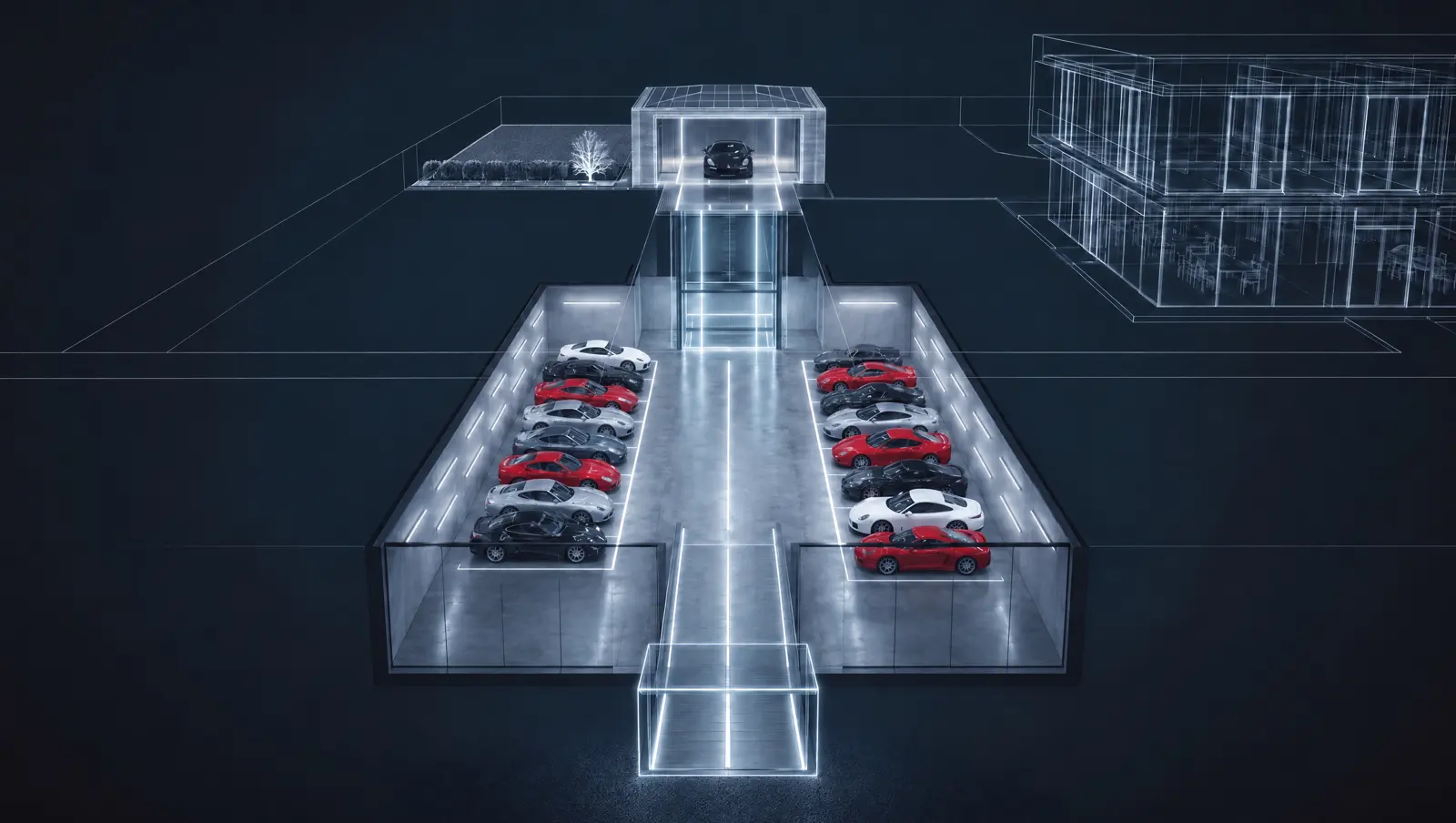
Discretion comes first
We offer an NDA on request, before we speak if you prefer. Nothing about your project is published or shared without your written consent. Your name and your address are never disclosed.
Every tradesperson signs a confidentiality agreement. Vans are unmarked, there is no site signage, and nothing is posted on social media. Drawings are issued on a need-to-know basis. Planning drawings are public, so security detail is kept out of them.
One named point of contact
One BELOW lead runs the project from the first call to handover, and stays your contact after it. You deal with one person, not a chain of contractors.
If you prefer, we work through your agent, your family office or your club's relocation contact instead. Reports go to whoever you choose, in the format that suits them.
Security from the estate edge to the car
Security is designed in ten layers: the perimeter, the approach, the house, the pavilion, the lift, the ramp, an air lock, the gallery shell, a key store and the car itself. No car keys and no gallery codes are kept in the house.
Published insurer guidance asks for a secure, enclosed space with access limited to trusted and vetted people. We design with your insurer from the first sketch. Our car gallery security guide sets out every layer.
Privacy from the road
A gallery below ground has no windows, and the only building above it is a pavilion that reads as a garden room. Planting, banks and walls control the approach without looking like a fortress.
Insurer guidance suggests blinds or coverings on any windows, so stored cars cannot be seen from outside. Where the pavilion is glazed, it is designed so the car on the lift cannot be seen from the road.
A gallery for the cars
A BELOW gallery is a single level, about 4.5m deep, for around 16 cars. You drive forward onto a lift in the pavilion and forward off it below, and an independent ramp is the second way out. Our residential car lift guide explains how it works.
The air is dried and held steady, the fire strategy is agreed with your insurer, and the cars are lit like a private gallery. Our car vault guide explains what protects them.
Building around a season
Tell us the dates that matter, and we plan the programme around them. The noisiest work, the excavation, can be timed for when the house is quiet.
Some planning surveys, such as bat surveys, can only be done in certain months, so we start them early. You or your adviser receive a short report each month, on the same day and in the same format.
How a project starts
- A private consultation, at your home, ours or through your adviser, about the house, the cars and how you live.
- A feasibility study covering the site, the planning route, the ground and the lift.
- A costed proposal with a programme, before anything is committed.
Our underground garage cost guide explains what drives the budget.
Questions
- Will you sign an NDA?
- Yes, on request, and before we speak if you prefer. Nothing is published or shared without your written consent, and your name and address are never disclosed.
- Can we deal through my agent or family office?
- Yes. We can work through your agent, your family office or your club's relocation contact, with one named BELOW lead on our side.
- Can the build fit around my season?
- Yes. Tell us the dates that matter, and we plan the programme so the noisiest work falls when the house is quiet.
- Can people see the cars from the road?
- No. The gallery is below ground with no windows, and the pavilion is designed so the car on the lift cannot be seen from outside.
- How does a project start?
- With a private consultation, then a feasibility study, then a costed proposal with a programme, before anything is committed.